.

A targeted list of literary agents representing:
MYSTERY / SUSPENSE / THRILLER
COMMERCIAL / ESPIONAGE and other genres

most of these agents also represent mainstream fiction / nonfiction

Canadian Literary Agencies are here

More or less alphabetical listing (last name or company name):

[ A ] [ B ] [ C ] [ D ] [ E - F ] [ G ] [ H ] [ I - J - K ]
***
[ L ] [ M - N ] [ O - P ] [ R ] [ S ] [ T - V ] [ W - Z ]

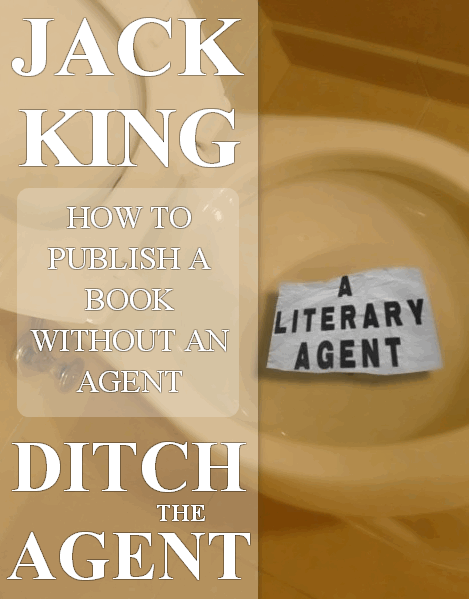
Getting your book published, or how to grow thick skin, quickly.

The success of books on getting published can be attributed to the upbeat style in which they are written. They offer hope, everything is possible - just write your novel, get an agent and the world will bend over backwards for you.

Folks, at the risk of sounding like the only downer in the industry, let me be painfully honest with you: finding an agent is the most depressing aspect of being a writer. The types of replies you will receive, or lack there of, only makes this process more stressful. If you've finished your story and think that the worst is over, my advice is to take a good long holiday. You will need all the strength you can gather because you are up for a nasty ride: trying to find an agent.

Pitching a fiction book idea without a book being written will not work unless you are a celebrity, or someone with a good deal of clout (for example a war criminal or someone who slept with everyone in the White House, or both, etc). Of course we all heard about miraculous exceptions (such as selling a novel based only on a synopsis, or a couple of sample chapters, etc), but for the sake of this article I am assuming that you are among the struggling majority.

To be considered by an agent or a publisher you will have to write and complete your novel first. Aim for 95,000 - 110,000 words. Some publishers accept shorter, 50,000 - 70,000 words, for example Harlequin. Just how much is 95,000 words? As an example my first two novels are 95,500 words long. That's just under 400 manuscript pages, using Word, 12 pt Times New Roman font, double spaced.

Next:

1. Prepare a synopsis - most agents like 1-2 paragraphs, some ask for a full page, few want to see 3-6 pages.

2. Write a query letter.

3. Query.

As a general rule, a query letter should be about one page (email is excellent as you can make it longer and no one will ever know) and should include a short description of your novel, your bio (if relevant), story length and genre. Address your query to a specific person rather than a submissions department.

If you are using my listings one thing you should know is that I prepared it for my own use. It is more or less alphabetical, and targets those agents who represent thrillers, mysteries, suspense and related genres. Most of those agents also represent mainstream, literary and other genres. Some may temporarily suspend representation of certain genres. Whenever possible I mentioned AAR affiliation or complaints against particular agents. You should always do further research to make sure agents are legit, active in their field, and have a track record.

Keep in mind that agenting is a very competitive business (not as competitive as being a writer, naturally) where things change frequently - people move places, some drop out of the game or their requirements change temporarily. Verify agency affiliations.

Always query before sending your MS.

Many agents prefer snail-mail queries, but a growing number accept email, or email-only queries. Of those agents that require snail-mail queries, almost all ask that you include a Self Addressed Stamped Envelope (SASE) with your query, even though many of them will reply to you by email (if included). Most agents will reply with a standard "No thank you" or "Not right for me" note, often photocopied and crudely cut out, some may explain why they are not interested, though these are very rare. Many will never reply, even if you include a SASE (see my listings). Of the 423 agents I queried (200 by snail), less than half replied, and of those that replied only 6 requested the manuscript for consideration, and all 6 requests came through email. Of those, one wanted $100 to further represent me, one read it over the weekend and decided that the novel had too much "blood and guts" for his Christian contacts in the publishing house, 2 agents whose representation I declined, and the remaining two were taking so long reading it that meanwhile I sold the novel myself.

When one agent declines to see your MS, try another from the same house or wait several weeks and query again (I've had some success on second try). Incidentally, what elevated the number of replies I received (though oddly enough not the sort of replies I was hoping for) was the change of tactic. (you too will scratch your head after several hundred rejections and will try new tricks...) I kept a detailed list of agents queried and would run through it once a week. When someone did not reply, I would send a follow up query with this opening line: "Whom do I have to sleep with to get representation". Although most declined the service, many took the time to reply. One agent even asked for the MS, and eventually offered to represent it, though her contract was so long and difficult to understand that I declined it.

Some agents will ask for partial (for example the first 50 or 100 pages, or the first 3-5 chapters) others will want full MS for consideration. Print it single-sided and double-spaced. Have a synopsis ready - some agents may like your story after reading only a few pages and to save time will want to see the synopsis, rather than reading the rest. In many cases agents employ outside readers who screen manuscripts on their behalf and do more than that. Many agents don't even open their mail - someone else, often shared by several agents, works as an office manager sending out rejections, answering the phone, etc. Your query / submission may not even be read by the agent at all. Treat a synopsis as a concise novel. What works best for me fits on one page - major developments, characters, etc. (The synopsis you include with the query letter should be no more than a paragraph, so have 2 of those ready, one for querying and one for including with the MS).

Some agents will request exclusive rights to read your MS and will not consider it if you are submitting to others at the same time. If this happens, make sure that they get back to you in a timely manner. Time is money not only for them but for you as well. More importantly, it is the stress of awaiting another rejection, with just a glimmer of hope: perhaps this time, perhaps this agent will fall in love with it...

Some agents will request the MS but you will never hear from them again (Joe Veltre). They will not reply to follow ups either. Did they hate the story that much? Or, did they sell the MS on Ebay? Do they screen manuscripts on behalf of the government? Do they find some perverse pleasure knowing you just spent 30 bucks printing and sending the MS for nothing? Who knows?

And, if you think this isn't depressing enough listen to this: Some agents will telephone you at home after reading your manuscript, saying how much they loved it (Jeffery McGraw of August Agency, co-partner is Cricket Pechstein). They will tell you that the book was read by several folks at their end, and they all loved it. They will talk to you at length about the book, about your writing career and prospects and offer representation. They will tell you to expect an agency agreement (contract) shortly. Yeeppie! Three weeks later you will receive an email saying they changed their mind because your book is not The Da Vinci Code, you're not Michael Crighton or James Patterson or some other author who spent several decades biulding his/her career and therefore chances of receiving big money for your project are not worth the agency's efforts... How about that?

There is more. Some agents will add your name, email address and your IP to their black list / spam filters, in fact this is a growing trend. To contact more agents from a house that blacklisted you, you'll have to either: get another email address, or change your signature / title, use a different IP or even a computer. You should fairly quickly realize the reality of being a writer in search of an agent: agents would be happier if only they did not have to deal with writers. Sure, you may say that it isn't fair of me to generalize, but tell me this after you've queried 400 agents, most of whom did not reply.

The bottom line is: Be prepared for rejections, they are part of every writer's life. The sooner you realize it and the sooner you grow thick skin the easier it will be to deal with them. Insist on a more detailed explanation why your work is being rejected. Simple reply "Not right for me" is not helpful. Treat rejection as a learning opportunity but never assume that a rejection means you're a lousy writer or that your book is too crappy to be published. Judging a writer is like judging figure skaters, it is very subjective and depends on the judge's personal taste. Think about your own reading tastes and those of your friends' who insist you must read this or that, only to find out what total shlock it is... Hey, if you want to get a good laugh get the "Rotten Rejections: The Letters That Publishers Wish They'd Never Sent" by Andre Bernard and see what some of the most popular writers in the World received in their mailbox.

Finally, you do not need an agent to get published. Querying a publisher directly, may result in getting The Call. Hell, some publishers encourage unagented submissions. I emailed one such publisher just before Noon. He replied within an hour, requesting the MS. Several weeks later he called and made an offer. After four weeks of negotiations we agreed on the contract. Rejections from agents kept coming for several months thereafter.

Negotiating a contract is not very difficult. There are very good books helping you understand the process. Once you get a contract you can (and should) hire a lawyer specializing in literary rights to help you understand it and point out advantages / disadvantages. These guys don't come cheap though. Mine charged $600.00/hr, but it was worth the peace of mind. The guy also owns one of the largest/most respected literary agencies in the country (though they never returned my SASE). When asked: "Should I hire an agent?", the lawyer replied "Jack, you don't need an agent, you have a lawyer." Well, perhaps, but I still would prefer to have one, just so I could write instead of worrying about finding publishers who would translate my novel...

An editor (former top exec at Hearst) I met at the Book Expo, when asked if she would be more willing to look at my MS if submitted by an agent, had this to say: "In my extensive experience I really do not trust them, had a few bad experiences with them, they seem to promise you the world, charge you a small fortune, and never seem to deliver just what they outline to you."

I'm not saying that you should give up looking for an agent, just consider that not having one is not the end of the world.

Do keep in mind that the above observations are based on my own experience. Yours may be quite different.

I am raising a glass of wine, wishing you the best of luck because you need it and deserve it: To You!

*

A targeted list of literary agents representing:
MYSTERY / SUSPENSE / THRILLER
COMMERCIAL / ESPIONAGE and other genres

most of these agents also represent mainstream fiction / nonfiction

Canadian Literary Agencies are here

More or less alphabetical listing (last name or company name):

[ A ] [ B ] [ C ] [ D ] [ E - F ] [ G ] [ H ] [ I - J - K ]
***
[ L ] [ M - N ] [ O - P ] [ R ] [ S ] [ T - V ] [ W - Z ]

© Jack King

.